

UW–Madison Research Reveals Experiences of HMoob (Hmong) Undergraduates Across Universities of Wisconsin
New Report Covers Trends in Enrollment, Belonging, Financial Need, Identity
March 25, 2026 | By Karen Rivedal, Office of Research & Scholarship

Researcher Bailey Smolarek and her team have issued a new, richer report on the HMoob student college experience in Wisconsin.
An updated statistical portrait of HMoob (Hmong)* American undergraduates enrolled in the 13 campuses of the Universities of Wisconsin reveals a college experience marked by unique challenges and opportunities. These enrollees, compared to their peers, are less wealthy and less likely to report having a disability. They are also twice as likely to be the first in their family to attend college, at two-thirds of HMoob first-year students compared with one-third for the same category in the general student population.
“These statistics showcase the diversity found within the HMoob student population,” said Bailey Smolarek, co-principal investigator, along with fellow researcher Matthew Wolfgram, of the study, which is funded by a $2.2 million grant from the National Science Foundation and based at the School of Education’s Wisconsin Center for Education Research (WCER) at UW–Madison. “The findings highlight the social and educational needs of this group and demonstrate the importance of examining the enrollment and demographic trends of historically underrepresented populations.”
HMoob people were resettled in Wisconsin as refugees at the end of the United States’ secret war in Laos (which included many HMoob soldiers fighting for the U.S.) starting in 1975 and continuing in waves through 2006. Today, Minnesota and Wisconsin are home to some of the largest HMoob communities in the country. HMoob are also Wisconsin’s largest Asian American population.
No reliable demographic data on HMoob college students in Wisconsin was available before 2009, when all Universities of Wisconsin campuses began offering the opportunity for students to self-identify as HMoob in enrollment applications. Prior to that, they were aggregated under the umbrella term Asian American.
The new report was built from three sources: institutional statistics from 2018 to 2024, findings from a survey of degree-seeking HMoob undergraduates administered by the research team in spring 2023, and interviews with HMoob students at four of the campuses. That approach produced a mixed-methods study painting a richer picture of this student group than a 2019 report from the same team.
Looking at the data from both reports also reveals a potential concern. The reports show HMoob enrollment in the Universities of Wisconsin growing from 2009 to 2015, then steadily dropping to about 1,700 undergraduates, where it has remained in recent years.
“We know the general HMoob population in Wisconsin has grown and is a relatively young population,” Smolarek said. “So, we should have expected to see the enrollment of HMoob students to grow, but the opposite has happened.”
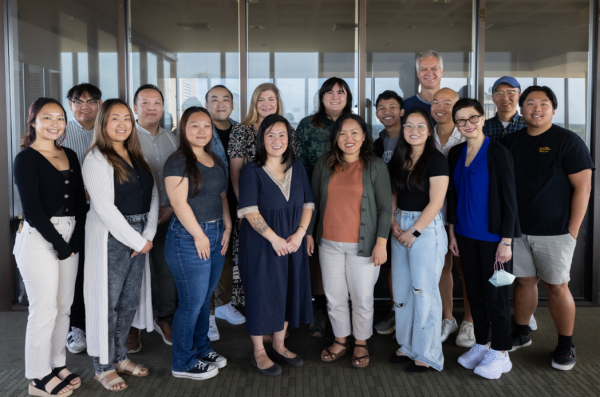
Members of the College Paj Ntaub team in 2024.
The new report is part of the College Paj Ntaub study, now in its 8th year, and is the main project of WCER’s Student-Engaged Participatory Action Research Center. In addition to Smolarek and Wolfgram at WCER, co-principal investigators include Kong Pheng Pha (Gender and Women’s Studies and Asian American Studies), Stacey Lee (Educational Policy Studies) and Choua P. Xiong (Hmong Studies and Anthropology, UW–Oshkosh).
The larger research team also includes additional researchers and students from UW–Madison and UW–Oshkosh; current members are You-Geon Lee, Chundou Her, Elijah Lin, Kaj Tug Lee, Steven Yang, Edward Xiong, Susan Vang, Kayeng Yang, Mai Chong Yang, Andy Yang, Vincent Lee, Pangra Yang, Javit Thao, and Seng Yeng Lee.
Key findings of the new report are:
- High rates of financial precarity. About 70% report financial concern or hardship. Nearly 30% have experienced housing insecurity and 23% have experienced food insecurity, despite many working 11 or more hours per week. About 68% receive Pell grants, compared with 24% of total eligible undergraduate students.
- Small but significant representation. HMoob students make up 70% of Southeast Asian undergraduates, but only 1.2% of all undergraduates. Enrollment has declined at most campuses since 2018, except for UW–Madison, UW–Milwaukee, UW–La Crosse, UW–Green Bay and UW–Whitewater.
- Diverse religious identities. A majority (59%) practice traditional HMoob religion, with implications for excused absences and other accommodations.
- Need for increased intersectional support. Despite the general “hyperheterosexualization” of HMoob people, approximately 11% identified as gay, lesbian, or bisexual and 1.3% identified as transgender or non-binary.
- Need for more support for students with disabilities. About 5% identified as having a disability and less than 2% reported registering that disability to obtain official accommodations, compared to 10% of the general student population. This indicates that HMoob students with disabilities may be overlooked by current support service mechanisms.
In addition to reporting on HMoob students’ demographics, the report also includes one of the team’s major findings about campus belonging, which shows participation in HMoob Studies and involvement in academic and campus social life is associated with higher campus belonging, while experiencing or witnessing a racist and/or discriminatory campus climate has negative impacts. Moreover, the positive correlation between participating in HMoob Studies and feeling belonging on campus and in one's major is even more pronounced for STEM (science, technology, engineering and math) majors, indicating a need to provide HMoob students, as well as other students of color, more support and resources to engage in Ethnic Studies courses.
*Both spellings are pronounced the same. The research team uses the spelling “HMoob,” in place of “Hmong,” to acknowledge the many dialects of the language.
About the Student-Engaged Participatory Action Research Center (SEPARC)
SEPARC partners with historically marginalized or minoritized student groups in higher education settings to investigate the educational issues and experiences important to them through critical race, decolonial, and feminist lenses. Learn more at studentengagedpar.wceruw.org.
About the Wisconsin Center for Education Research (WCER)
WCER at UW–Madison’s #1-ranked School of Education is one of the world’s oldest and most productive education research centers. WCER has supported researchers and scholars in developing, submitting, conducting and sharing grant-funded education research for over 60 years. See wcer.wisc.edu for additional information.